



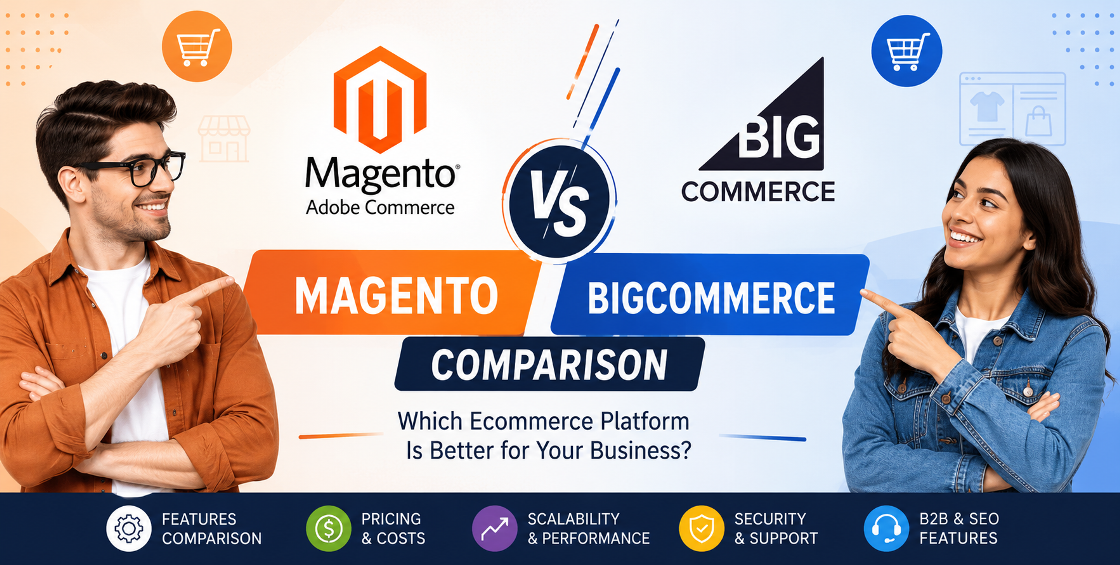
Magento vs BigCommerce: Which Ecommerce Platform Is Better for Your Business?
One online retailer approached us after expanding from 3,000 products to nearly 80,000 SKUs. Their marketing campaigns were performing well, but the backend told a different story. Product attributes weren't syncing correctly, category pages contained duplicate listings, and updating inventory across multiple sales channels had become a daily struggle.
The problem wasn't the products.
It was choosing a platform that no longer matched the scale and complexity of the business.
This is where the Magento vs BigCommerce debate becomes more than a software comparison. The right platform influences everything from catalog management and SEO performance to order processing, integrations, and long-term operating costs.
If you're deciding between Magento and BigCommerce, here's a practical look at how both platforms perform in real ecommerce environments.
Magento and BigCommerce: The Fundamental Difference
Although both platforms power successful online stores, they follow very different philosophies.
Magento (Adobe Commerce) is designed for businesses that want complete control over every aspect of their online store. It offers unmatched customization but usually requires experienced developers for implementation and maintenance.
BigCommerce, on the other hand, is a hosted SaaS platform. Most of the technical infrastructure is managed for you, allowing teams to focus more on selling products than maintaining servers and software updates.
Think of it this way:
- Magento is like owning a custom-built warehouse.
- BigCommerce is like renting a modern logistics facility that's already maintained for you.
Neither is universally better. The better choice depends on your business model.
Feature-by-Feature Comparison
Ease of Setup
BigCommerce is considerably easier to launch.
Most merchants can configure themes, payment gateways, shipping rules, and products without extensive technical knowledge.
Magento implementation often involves:
- Server configuration
- Security setup
- Theme development
- Module installation
- Performance optimization
- Ongoing maintenance
For companies without an in-house development team, Magento projects usually require agency support.
Winner: BigCommerce
Customization
Magento remains one of the most flexible ecommerce platforms available.
Nearly every aspect can be customized:
- Checkout
- Product pages
- Customer groups
- Pricing logic
- Inventory workflows
- Promotions
- Integrations
BigCommerce supports customization as well, but within a managed framework that prioritizes stability.
If your business has highly specialized workflows, Magento generally offers greater flexibility.
Winner: Magento
Product Catalog Management
This is where many businesses underestimate the operational workload.
Uploading 200 products manually isn't difficult.
Managing 150,000 SKUs across multiple brands, warehouses, currencies, and marketplaces is an entirely different challenge.
Large catalogs introduce issues like:
- Duplicate products
- Attribute inconsistencies
- Variant errors
- Broken image links
- Incorrect pricing
- Missing metadata
- Category conflicts
Magento handles highly complex catalog structures exceptionally well when configured correctly.
BigCommerce also performs strongly but is often easier for smaller merchandising teams to maintain due to its simplified administration interface.
At India Data Entry Services, we've worked with businesses maintaining catalogs containing tens of thousands of products. In many cases, operational success depended less on the ecommerce platform itself and more on having consistent catalog management processes behind it.
SEO Capabilities
Both platforms offer solid SEO foundations.
Magento provides greater control over:
- URL structures
- Canonical tags
- Metadata
- Schema customization
- XML sitemaps
- Redirect rules
BigCommerce includes many SEO features out of the box, reducing the need for additional development.
For businesses with advanced SEO requirements, Magento offers more flexibility.
For teams wanting strong default SEO settings with less technical effort, BigCommerce is often sufficient.
Winner:
- Advanced SEO: Magento
- Simplicity: BigCommerce
Performance
Site speed affects both conversions and search rankings.
BigCommerce benefits from managed cloud hosting, where infrastructure optimization is handled automatically.
Magento performance depends heavily on:
- Hosting quality
- Server configuration
- Cache implementation
- CDN usage
- Extension quality
A well-optimized Magento store can be extremely fast.
A poorly maintained one can become difficult to manage.
Winner: BigCommerce
Security
Security responsibilities differ significantly.
With BigCommerce:
- Hosting is managed
- Security updates are automatic
- PCI compliance is largely simplified
Magento users are generally responsible for:
- Security patches
- Server updates
- Backup management
- Monitoring
- Compliance
Businesses with dedicated IT teams often appreciate Magento's flexibility.
Smaller businesses usually prefer BigCommerce's managed approach.
Winner: BigCommerce
B2B Features
Both platforms support B2B commerce.
Magento excels in highly customized B2B environments with features like:
- Company accounts
- Custom pricing
- Approval workflows
- Purchase orders
- Shared catalogs
BigCommerce also supports B2B selling, particularly when using its B2B Edition and integrations.
Large manufacturers and distributors often choose Magento because of its deeper customization capabilities.
Winner: Magento
Hidden Operational Costs That Rarely Appear in Comparisons
Software licensing tells only part of the story.
Operational costs often include:
- Product data cleanup
- Catalog enrichment
- Marketplace synchronization
- Image optimization
- Duplicate listing removal
- Attribute mapping
- Data migration
- Quality assurance
One company spent nearly a month correcting inconsistent product options after migrating from an older ecommerce platform. The migration itself wasn't the problem. The product data hadn't been standardized before import.
These are expenses many businesses overlook during platform selection.
Which Platform Works Best for Different Businesses?
Choose Magento If...
- You manage complex product catalogs.
- Your business requires custom workflows.
- You have access to experienced developers.
- You expect significant long-term customization.
- You're building enterprise-level ecommerce operations.
Choose BigCommerce If...
- You want faster deployment.
- Your technical resources are limited.
- You prefer predictable maintenance.
- Your catalog structure is relatively straightforward.
- You want to spend less time managing infrastructure.
Migration Considerations
Changing ecommerce platforms isn't simply exporting products and importing them elsewhere.
Successful migrations typically involve:
- Product attribute mapping
- Category restructuring
- URL redirect planning
- Customer migration
- Order history migration
- SEO preservation
- Image verification
- Inventory validation
- Quality testing
Skipping these steps can lead to broken pages, missing products, duplicate listings, and ranking losses.
Businesses often discover that data preparation takes longer than the technical migration itself.
The Right Platform Depends on Your Growth Strategy
The question isn't whether Magento is better than BigCommerce.
It's whether your future operations match the platform's strengths.
Businesses expecting highly customized workflows, advanced integrations, and complex B2B operations often find Magento to be a better long-term investment.
Companies that value simplicity, faster implementation, and reduced maintenance frequently choose BigCommerce.
Platform selection should account not only for today's product catalog but also where the business expects to be in three or five years.
Even the best ecommerce software cannot compensate for inconsistent product data, poorly organized catalogs, or inefficient backend workflows. That's why experienced ecommerce teams invest as much attention in catalog management as they do in platform selection. At India Data Entry Services, we've supported global retailers with product uploads, catalog maintenance, marketplace listing management, and data migration projects that keep large ecommerce operations running smoothly behind the scenes.
Frequently Asked Questions
Is Magento better than BigCommerce?
Magento offers greater customization and flexibility, while BigCommerce is easier to manage and requires less technical maintenance. The better choice depends on your business requirements.
Which platform is more suitable for large product catalogs?
Magento is generally preferred for businesses managing highly complex catalogs with extensive attributes, custom pricing, and advanced inventory structures.
Is BigCommerce easier to use?
Yes. BigCommerce provides a more user-friendly administration interface and manages hosting, updates, and security, reducing technical overhead.
Which platform offers better SEO?
Magento provides deeper SEO customization, while BigCommerce includes many SEO best practices by default. Both platforms can achieve excellent search performance when implemented correctly.
How difficult is migrating from Magento to BigCommerce?
Migration complexity depends on the size of your catalog, customizations, customer data, and SEO requirements. Careful planning and data validation are essential for a successful transition.