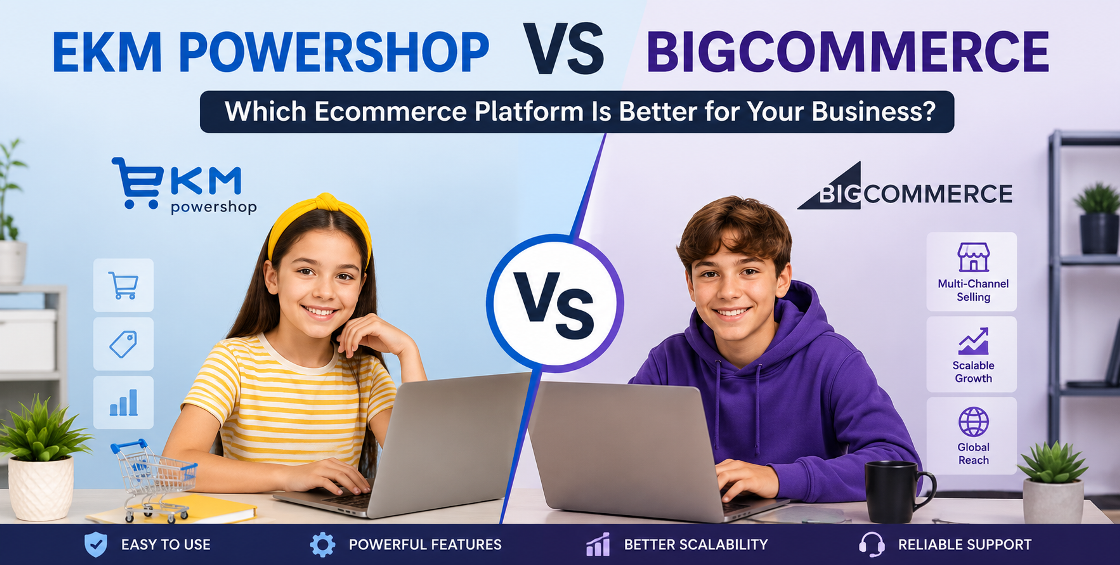
EKM Powershop vs BigCommerce: Which Ecommerce Platform Is Better for Growing Online Stores?
Choosing an ecommerce platform often feels straightforward when you're launching with 20 or 30 products. The real test begins months later when the catalog grows into thousands of SKUs, multiple suppliers, seasonal inventory updates, and listings across several sales channels.
Uploading 50 products manually is manageable. Updating 15,000 products with different prices, images, stock quantities, and product variations every week is an entirely different operation.
That difference is exactly why businesses compare platforms like EKM Powershop and BigCommerce. Both promise an all-in-one ecommerce solution, but they approach online selling from different perspectives.
If you're deciding between the two, here's what matters beyond the marketing pages.
Understanding Both Platforms
What is EKM Powershop?
EKM Powershop is a UK-focused ecommerce platform designed primarily for small and medium-sized businesses. It provides hosting, templates, payment integrations, and store management tools in one package.
Many retailers appreciate its simplicity and local support, especially businesses serving the UK market.
Ideal for:
- Small retailers
- Local businesses
- First-time online sellers
- Companies with relatively straightforward product catalogs
What is BigCommerce?
BigCommerce is a cloud-based ecommerce platform built for businesses expecting growth.
It supports advanced product options, multi-channel selling, B2B functionality, extensive API access, and enterprise-level customization without requiring merchants to manage hosting infrastructure.
It's commonly selected by businesses operating nationally or internationally with larger product catalogs.
Ideal for:
- Growing ecommerce brands
- Multi-store businesses
- B2B companies
- High-volume retailers
- International sellers
Side-by-Side Comparison
| Feature | EKM Powershop | BigCommerce |
|---|---|---|
| Ease of setup | Excellent | Very good |
| Product management | Good | Excellent |
| Scalability | Moderate | High |
| Multi-channel selling | Basic | Extensive |
| SEO features | Good | Excellent |
| API flexibility | Limited | Advanced |
| B2B capabilities | Limited | Strong |
| International selling | Basic | Excellent |
| App ecosystem | Moderate | Large |
| Enterprise readiness | Limited | Excellent |
Product Catalog Management: Where Differences Become Noticeable
Many software comparisons stop at design templates and pricing. Daily operations tell a different story.
Imagine updating:
- 12,000 apparel products
- Five warehouse locations
- Three currencies
- Multiple marketplaces
- Thousands of product images
This is where catalog management becomes the deciding factor.
BigCommerce provides stronger support for:
- Bulk product imports
- Product variants
- Custom product fields
- API-driven automation
- ERP integrations
- PIM connectivity
EKM handles everyday catalog management well but can become more restrictive for businesses managing highly complex inventories.
At India Data Entry Services, we've worked with retailers maintaining catalogs that exceed tens of thousands of SKUs. In many of those projects, the platform itself wasn't the bottleneck—the challenge was keeping product data accurate across every sales channel.
SEO Capabilities
Organic search traffic often becomes one of the largest revenue sources for mature ecommerce stores.
Here's how both platforms compare.
EKM Powershop SEO
EKM includes:
- Editable page titles
- Custom URLs
- Meta descriptions
- Sitemap generation
- Canonical URLs
These features are sufficient for many smaller businesses.
BigCommerce SEO
BigCommerce offers more flexibility, including:
- Customizable URLs
- Structured data support
- Advanced redirects
- Google Shopping compatibility
- Optimized page speed
- AMP support for selected implementations
- Headless commerce options
For businesses investing heavily in content marketing and organic visibility, BigCommerce provides more room to grow.
Managing Large Catalogs
One common challenge appears during seasonal updates.
A fashion retailer may need to:
- Replace thousands of images
- Modify pricing
- Discontinue products
- Add new variations
- Update inventory daily
Without structured workflows, duplicate listings and inconsistent product information quickly appear.
One retailer approached us after their merchandising team spent nearly a month correcting product titles that had become inconsistent across multiple categories after repeated spreadsheet imports. The issue wasn't caused by the platform alone—it resulted from inconsistent catalog processes.
Whether using EKM or BigCommerce, disciplined product data management remains essential.
Integrations
Modern ecommerce stores rarely operate in isolation.
Most connect with:
- ERP software
- Accounting systems
- Shipping platforms
- Marketplaces
- CRM software
- Payment gateways
- Marketing automation tools
BigCommerce supports a broader ecosystem of integrations and APIs, making it a stronger choice for businesses with complex technology stacks.
EKM covers the essentials but focuses more on merchants looking for a simpler operational setup.
Multi-Channel Selling
Selling only through your website is becoming less common.
Retailers increasingly list products on:
- Amazon
- eBay
- Google Shopping
- TikTok Shop
BigCommerce offers stronger multi-channel management capabilities, helping synchronize products and inventory across multiple platforms.
This becomes particularly valuable as product counts increase.
Customization
Every retailer eventually encounters a requirement that falls outside standard templates.
Examples include:
- Custom pricing rules
- Industry-specific product fields
- Wholesale portals
- Customer segmentation
- Advanced checkout experiences
BigCommerce provides significantly more flexibility through APIs and developer resources.
EKM emphasizes simplicity over deep customization.
Pricing Considerations
The lowest monthly subscription rarely represents the true cost of ownership.
Also consider:
- Implementation
- Theme customization
- Product migration
- Catalog cleanup
- Third-party integrations
- Ongoing maintenance
- Staff training
A platform that appears less expensive initially may require additional manual effort as operations expand.
Which Businesses Should Choose EKM Powershop?
EKM is often a suitable fit if you:
- Primarily sell within the UK
- Operate a relatively small catalog
- Prefer an easy-to-manage platform
- Do not require extensive custom development
- Value simplicity over advanced features
Which Businesses Should Choose BigCommerce?
BigCommerce is generally the stronger option if you:
- Manage thousands of SKUs
- Sell internationally
- Operate multiple storefronts
- Require API integrations
- Expect rapid business growth
- Need advanced B2B capabilities
- Rely on marketplace selling
Migration Challenges to Consider
Changing ecommerce platforms involves much more than moving product listings.
Businesses frequently overlook:
- URL redirects
- Image migration
- Product variants
- Customer accounts
- Order history
- SEO preservation
- Category structures
- Metadata consistency
Planning these elements carefully reduces the risk of traffic loss and operational disruptions after launch.
Final Thoughts
Neither platform is universally better.
EKM Powershop delivers a user-friendly environment that works well for many smaller retailers, especially those focused on the UK market.
BigCommerce stands out when operational complexity increases. Larger catalogs, international expansion, advanced integrations, and multi-channel commerce are areas where it provides greater long-term flexibility.
The right decision depends less on where your business is today and more on where you expect it to be over the next several years.
If your team anticipates rapid catalog growth or marketplace expansion, it is worth evaluating not only platform features but also the processes behind product data, inventory updates, and listing management. At India Data Entry Services, we've supported businesses through large-scale product uploads, catalog maintenance, and ecommerce backend operations across multiple platforms, helping them keep data accurate as their online stores evolve.
Frequently Asked Questions
Is BigCommerce better than EKM Powershop?
BigCommerce generally offers more advanced features for larger businesses, while EKM Powershop is well suited to smaller retailers looking for an easier setup.
Can I migrate from EKM Powershop to BigCommerce?
Yes. Product data, categories, images, customer information, and other store content can be migrated with proper planning and testing.
Which platform offers better SEO?
Both include essential SEO features, but BigCommerce provides greater flexibility for technical SEO, structured data, redirects, and enterprise-level optimization.
Which platform is easier for beginners?
EKM Powershop is often easier for first-time ecommerce merchants due to its simpler interface and guided setup.
Which platform handles large product catalogs more effectively?
BigCommerce is generally better equipped to manage large catalogs, complex product variants, and high-volume inventory updates.