



When 200 Products Turn Into 20,000: The Hidden Chaos Behind Ecommerce Catalog Growth
Most ecommerce teams don’t realize where things start breaking.
It usually isn’t sales, ads, or even inventory.
It’s product uploads.
One retailer we worked with started with a clean Shopify store and about 180 SKUs. Within 18 months, they expanded to Amazon, Flipkart, and two regional marketplaces. Suddenly, their “simple catalog” turned into 14,000+ listings spread across platforms—with inconsistent titles, missing attributes, duplicate images, and pricing mismatches.
Their internal team spent more time fixing listings than launching new products.
This is where product upload services for ecommerce stores stop being optional and become operational infrastructure.
What Are Product Upload Services for Ecommerce Stores?
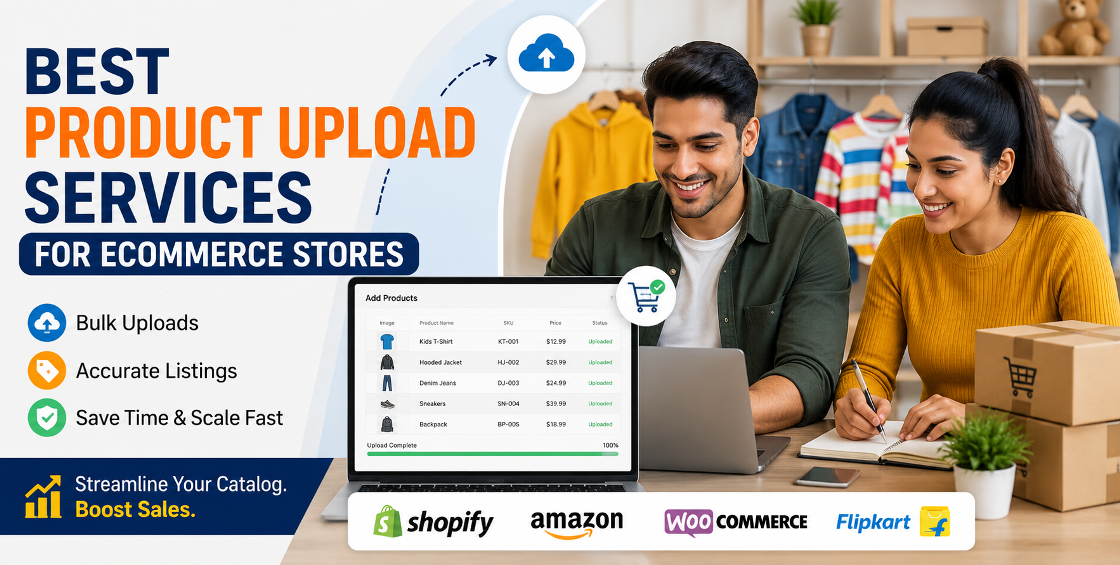
At a basic level, product upload services involve adding product data into ecommerce platforms like Shopify, Amazon, WooCommerce, Magento, or marketplace dashboards.
But in real operations, it’s much more than “uploading products.”
It includes:
- Structuring product data files (CSV, Excel, APIs)
- Optimizing titles and descriptions for marketplaces
- Mapping attributes (size, color, material, variants)
- Uploading images with correct naming conventions
- Handling bulk SKU uploads
- Fixing listing errors and rejections
- Ensuring consistency across multiple platforms
The real value lies in accuracy at scale, not just entry speed.
Case Study: The Brand That Lost 3 Weeks Fixing Duplicate Listings
A mid-sized fashion retailer approached us after a painful internal experience.
They had:
- 8,500 SKUs on Shopify
- 3 marketplace integrations
- A 5-person in-house operations team
The problem?
Their team unknowingly uploaded the same products multiple times with slight variations in naming conventions like:
- “Blue Denim Jeans Slim Fit”
- “Slim Fit Blue Denim Jeans”
- “Men Blue Jeans Slim Fit Denim”
Search rankings dropped on marketplaces, ads became inefficient, and inventory tracking became unreliable.
By the time they identified the issue, they had duplicate listings across Amazon and Flipkart affecting over 2,000 SKUs.
This is a common failure point when product uploads are handled without structured catalog systems.
Why Ecommerce Stores Struggle With Product Uploads
Most founders assume product listing is a “data entry task.”
In reality, it behaves more like a data engineering workflow.
Here’s where things break:
1. Unstructured Product Data
Suppliers send inconsistent Excel sheets. Half the attributes are missing or mislabeled.
2. Marketplace-Specific Requirements
Amazon wants bullet points. Shopify doesn’t care. Flipkart has strict category mapping rules.
3. Variant Complexity
Size, color, pack type, region-specific SKUs—each variation multiplies workload.
4. Human Error at Scale
Even a 2% error rate becomes 200 mistakes in a 10,000 SKU catalog.
5. Multi-Channel Sync Issues
A price update in Shopify doesn’t always reflect correctly on marketplaces.
What Professional Product Upload Services Actually Handle
A structured ecommerce product listing services provider doesn’t just upload data—they manage catalog integrity.
Core Services Include:
1. Bulk Product Upload Service
Handling thousands of SKUs through structured templates, APIs, or PIM systems.
2. Marketplace Listing Optimization
Adjusting product titles, descriptions, and keywords for Amazon, Flipkart, Meesho, and others.
3. Ecommerce Catalog Management Services
Maintaining consistency across platforms and preventing duplication or missing attributes.
4. Image Processing & Mapping
Ensuring correct image ratios, naming conventions, and variant mapping.
5. SKU Structuring
Creating logical SKU hierarchies for inventory tracking and reporting.
6. Data Cleansing
Fixing incomplete, duplicate, or inconsistent product data before upload.
At scale, these tasks are not optional—they directly impact conversion rates and ad performance.
In-House Teams vs Outsourced Product Upload Services
This comparison comes up in almost every ecommerce scaling discussion.
In-House Upload Teams
Pros:
- Full control over processes
- Faster internal communication
Cons:
- High training cost
- Limited scalability
- Error accumulation over time
- Slower onboarding for new marketplaces
Outsourced Product Upload Services
Pros:
- Scalable SKU handling
- Experienced with multiple platforms
- Standardized quality checks
- Faster turnaround for bulk uploads
Cons:
- Requires clear SOP documentation
- Needs initial onboarding alignment
At scale (10,000+ SKUs), outsourcing is less about cost and more about operational stability.
The Actual Workflow Behind Bulk Product Uploads
Here’s what a structured workflow looks like in professional setups:
Step 1: Data Collection
Product information is gathered from suppliers, ERP systems, or brand catalogs.
Step 2: Data Standardization
Titles, attributes, and categories are normalized.
Step 3: Template Mapping
Each platform (Shopify, Amazon, etc.) has a different upload structure.
Step 4: QA Validation
Missing fields, duplicates, and incorrect formatting are flagged.
Step 5: Bulk Upload Execution
Using CSV imports, APIs, or marketplace tools.
Step 6: Post-Upload Audit
Listings are checked for visibility, indexing, and accuracy.
At agencies like India Data Entry Services, this workflow is often repeated daily across multiple ecommerce clients handling thousands of SKUs.
Common Mistakes Ecommerce Teams Make
1. Ignoring Marketplace SEO
Uploading products without keyword-optimized titles reduces visibility drastically.
2. Inconsistent SKU Naming
Leads to inventory mismatches and reporting errors.
3. Copy-Paste Product Descriptions
Results in duplicate content penalties on marketplaces.
4. Missing Attribute Fields
Filters stop working correctly, reducing discoverability.
5. No Central Catalog System
Data lives in scattered spreadsheets instead of a structured system.
When You Actually Need Product Upload Services
Not every store needs outsourcing immediately.
But these signs are clear indicators:
- You manage more than 1,000 SKUs
- You sell on 2+ marketplaces
- Product launches are delayed due to listing bottlenecks
- Duplicate listings are appearing
- Your team spends more time fixing listings than uploading new ones
At this stage, product upload services for ecommerce stores become a scaling requirement, not a convenience.
Checklist Before Choosing a Product Upload Partner
- Experience with multiple marketplaces (Amazon, Shopify, Flipkart, etc.)
- Bulk upload capability (10K+ SKUs handling)
- QA and validation process
- SKU and variant management approach
- Turnaround time for large catalogs
- Data security and access control
- Reporting structure post-upload
A weak backend process here leads to long-term catalog instability.
Internal Link Opportunities
- Ecommerce Product Data Entry Services
- Shopify Product Upload Services
- Amazon Listing Optimization Services
- Bulk Data Entry Solutions for Ecommerce
- Catalog Management Services India
- Marketplace SEO Services
Final Thoughts
Product uploads are often underestimated because they sit behind the storefront.
But every conversion, search ranking, and ad performance metric depends on how clean and structured your catalog is.
Stores that treat listing operations as a core function—not a side task—scale faster with fewer operational breakdowns.
FAQ Section
1. What are product upload services for ecommerce stores?
They are services that handle bulk product listing, catalog structuring, and marketplace uploads across platforms like Shopify, Amazon, and Flipkart.
2. Why should ecommerce businesses outsource product uploads?
Outsourcing reduces errors, improves scalability, and ensures consistent catalog quality across multiple sales channels.
3. How do bulk product upload services work?
They use standardized templates, validation processes, and platform-specific mapping to upload thousands of SKUs efficiently.
4. Can product upload services improve SEO on marketplaces?
Yes. Optimized titles, descriptions, and attributes improve product discoverability and ranking on marketplaces.
5. What industries need catalog management services the most?
Fashion, electronics, FMCG, home decor, and multi-vendor ecommerce businesses typically require large-scale catalog management.